
A summer breeze suddenly gives way to crisp fall air and shades of red and yellow. But how? And why? There’s beauty in the annual rhythms of change, making seasons and the causes of seasons a natural launching point for real-world science investigation.
If you’re wondering how to teach seasons this school year, keep reading for engaging, low-prep ideas to try in your classroom.
Key takeaways for your classroom
- Seasons are caused by Earth’s 23.5° axial tilt, not the distance from the Sun.
- The causes of Earth’s seasons include changes in solar intensity and day length across hemispheres.
- When teaching seasons, incorporate opportunities for data analysis, modeling, and real-world contexts.
- Interactive investigations support sensemaking by allowing students to gather evidence and explain how the tilt of the Earth’s axis causes seasons.
- Story-driven science experiences improve conceptual understanding and engagement with the causes of seasons.
What causes seasons?
Students are familiar with the four seasons in their day-to-day lives: spring, summer, fall (autumn), and winter. But what are the causes of seasons? If your students think seasons happen because Earth is closer or farther from the Sun, you’re not alone. This is a very common misconception, even in high school. The truth is simpler and more powerful.
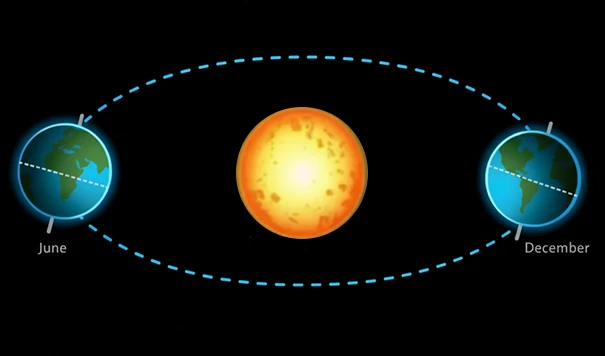
In reality, the 23.5° tilt of Earth’s axis causes the four seasons.
How does Earth’s tilt impact the seasons?
How does the tilt of the Earth’s axis cause seasons? As the Earth orbits the Sun, its 23.5° tilt causes different parts of the planet to receive varying amounts of sunlight at different times of year.
How do seasons change across hemispheres?
Earth is divided into the Northern Hemisphere and Southern Hemisphere by the equator, an imaginary line around the middle of the planet that receives the most direct sunlight year-round. Because of this division, each hemisphere can receive very different amounts of sunlight at the same time.
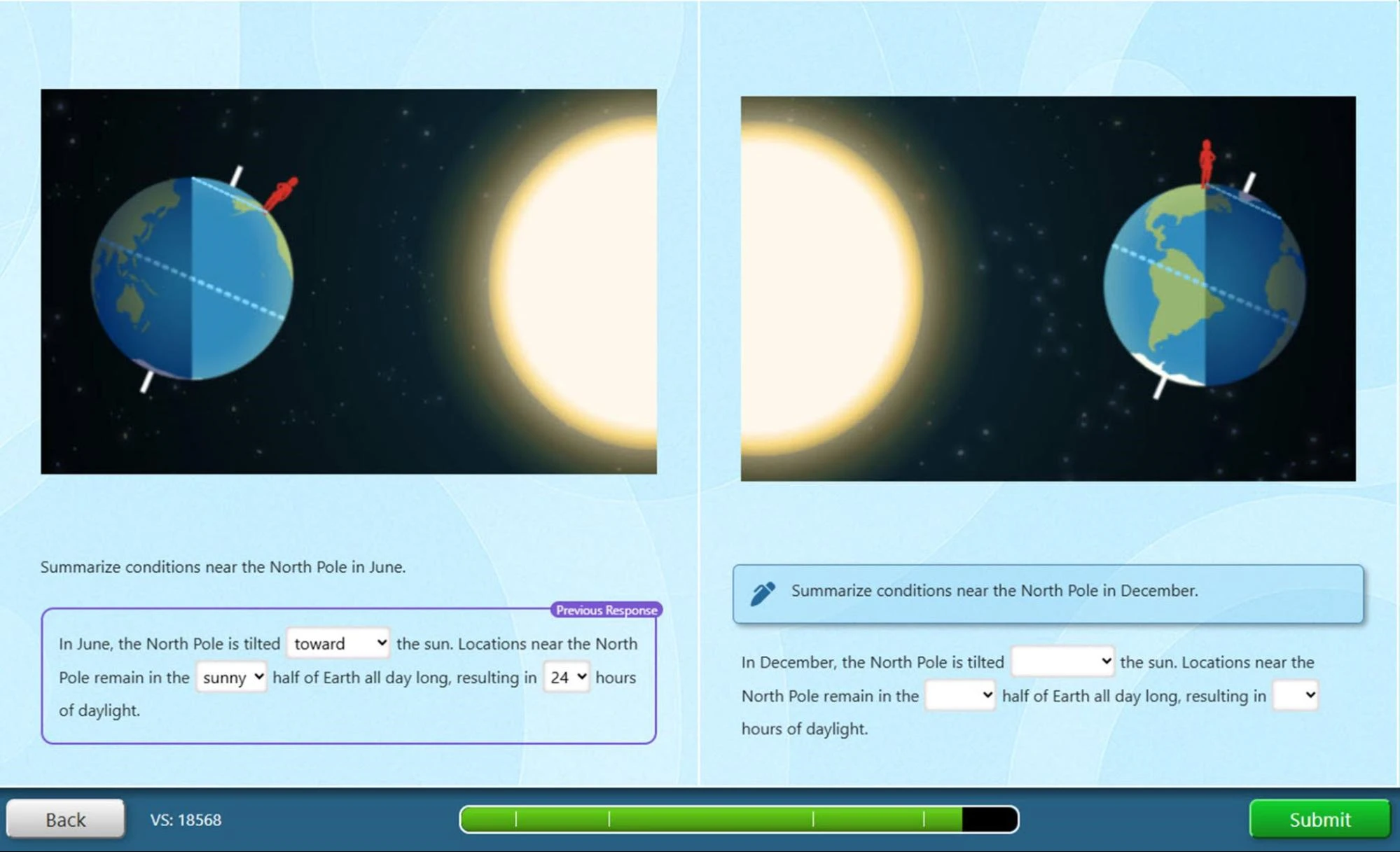
When a hemisphere is tilted toward the Sun, sunlight strikes at a more direct angle for a longer period of the day, resulting in warmer temperatures. When it’s tilted away, sunlight is less direct and days are shorter. Solstices (the longest and shortest days of the year) and equinoxes (when day and night are nearly equal in length) mark these shifts.
This means that while it might be summer for students in Arkansas (Northern Hemisphere), students in Australia (Southern Hemisphere) are experiencing winter!
Bring seasons to life for students
Students understand seasons best when they move beyond diagrams and start working with real models to see how Earth’s axis and orbit work together around the Sun. Instead of memorizing facts, interactive science lessons allow students to investigate patterns, observe, and test explanations, just as scientists do.
Well-designed lessons naturally lead students toward evidence-based discovery through engaging, real-world questions.
Kick off a lesson with high-interest questions, like:
- What are the four seasons?
- What do you notice about how the length of a day changes through the year?
- What do you notice about how high the sun gets in the sky through the year?
- Why do you think it is summer in Australia when it is winter in New York?
Importance of hands-on and interactive activities
Hands-on learning is especially important when teaching the seasons because students must visualize three-dimensional relationships and changes over time between Earth and the Sun. Simple classroom models—such as using a lamp for the Sun and students rotating to represent Earth’s orbit—help ground abstract ideas in physical experience.
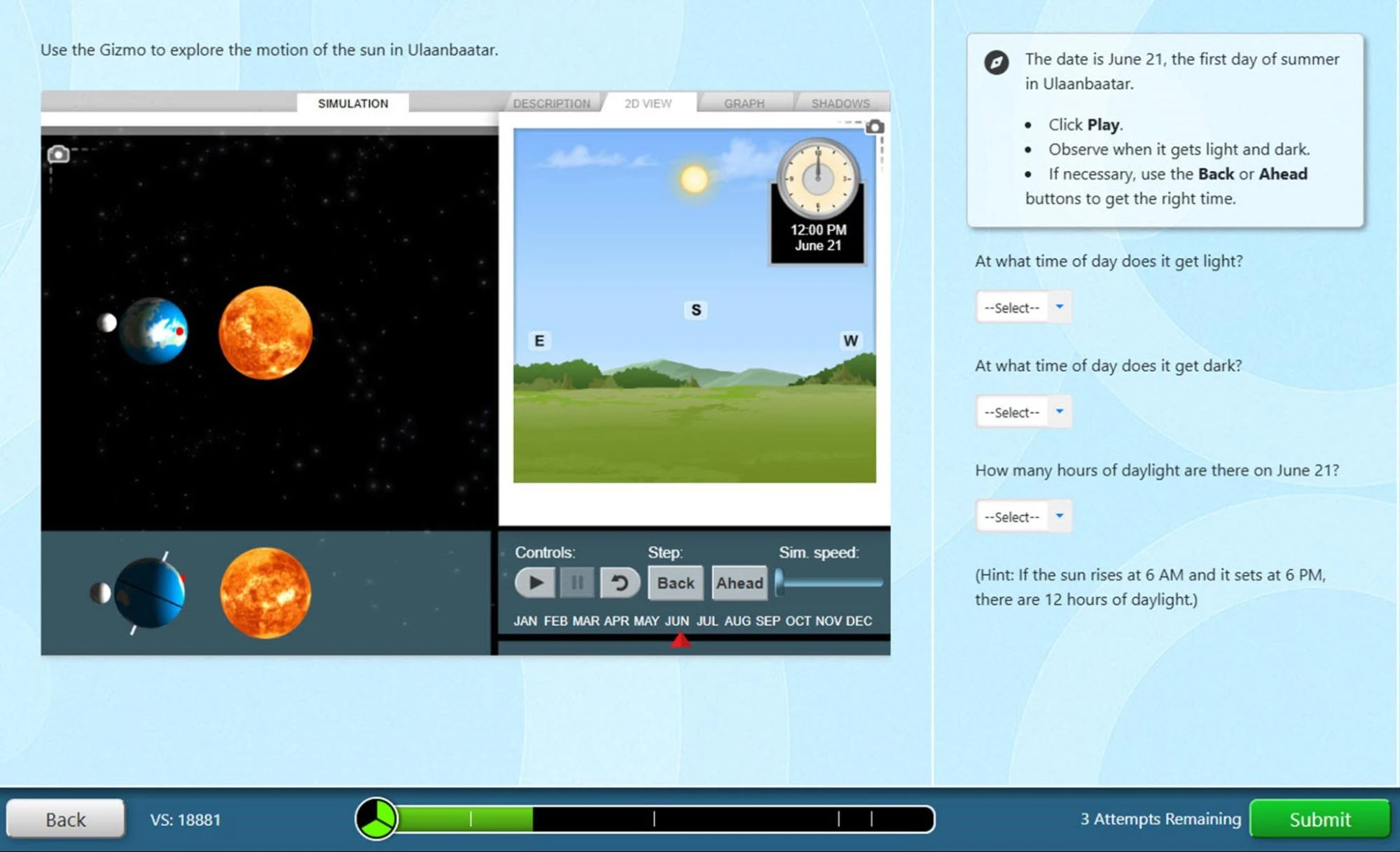
Virtual simulations extend learning by allowing students to safely model large-scale systems that can’t be replicated in the classroom. Interactive activities let students collect and analyze data on day length and solar intensity, build and revise models as new evidence emerges, and connect their observations to global patterns. When students manipulate variables and interpret results, abstract ideas become concrete.
Gizmos Investigations are designed for middle school science, helping you turn student questions into meaningful, standards-aligned learning experiences.
Teach the causes of seasons with Gizmos Investigations
Gizmos Investigations support inquiry-based learning by grounding abstract ideas, like Earth’s axial tilt and orbit, in observable, real-world phenomena. In the new Causes of Seasons Investigation, students ask questions, test hypotheses, and receive just-in-time feedback as they explore seasons.
Each Investigation wraps guided, scaffolded lessons around Gizmo simulations that teachers already know and trust. The Causes of Seasons Investigation embeds Earth–Sun system models from the Gizmos library, supporting sensemaking as students analyze data, explain patterns, and connect models to real-world seasonal change.
The Causes of Seasons Investigation aligns with middle school science standards and fits smoothly into Earth science and space science units, while also supporting coherence across the school year. This Investigation offers flexibility with a multi-day Series lesson to dive deep into big ideas, plus two standalone lessons perfect for a single class period.
Exploring seasons with a multi-day interactive lesson
In the interactive, multi-day lesson, Causes of Seasons: Training for Gold, students begin with a real-world challenge. Arban is a snowboarder training for the Mongolian Olympic team, but he can only train part of the year near his home in Ulaanbaatar. To help Arban find a summer training location, students explore climates around the world, discover that seasons are opposite across hemispheres, collect data on day length and solar intensity, and use evidence to explain how Earth’s tilt causes seasons.
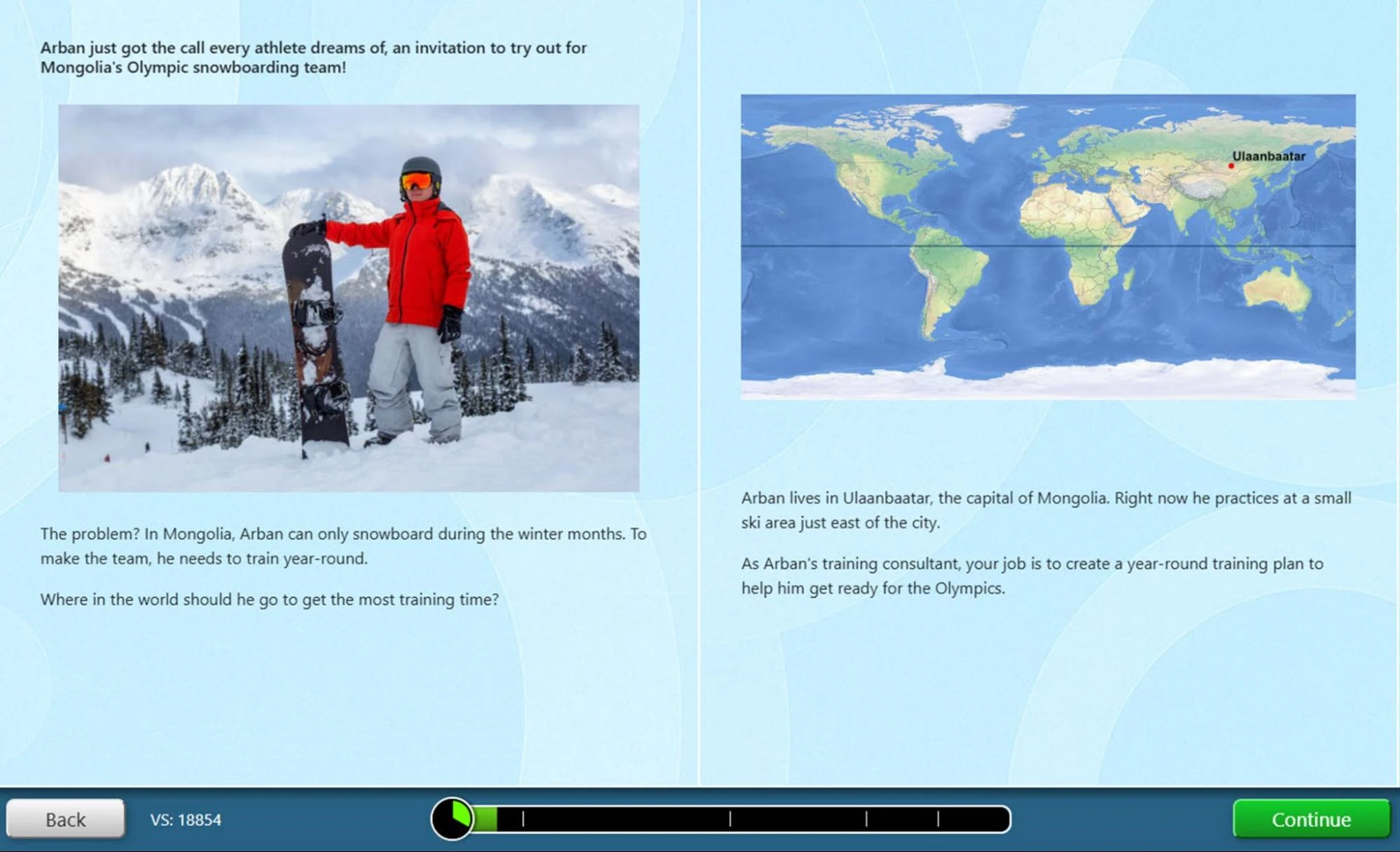
This Series Investigation engages students in key science practices, including planning investigations, analyzing data, developing models, and constructing explanations. By the end of the series, students will be able to:
- Compare seasonal patterns between the Northern and Southern Hemispheres
- Interpret data on solar intensity and day length to explain seasonal trends
- Build and revise models explaining why hemispheres experience opposite seasons
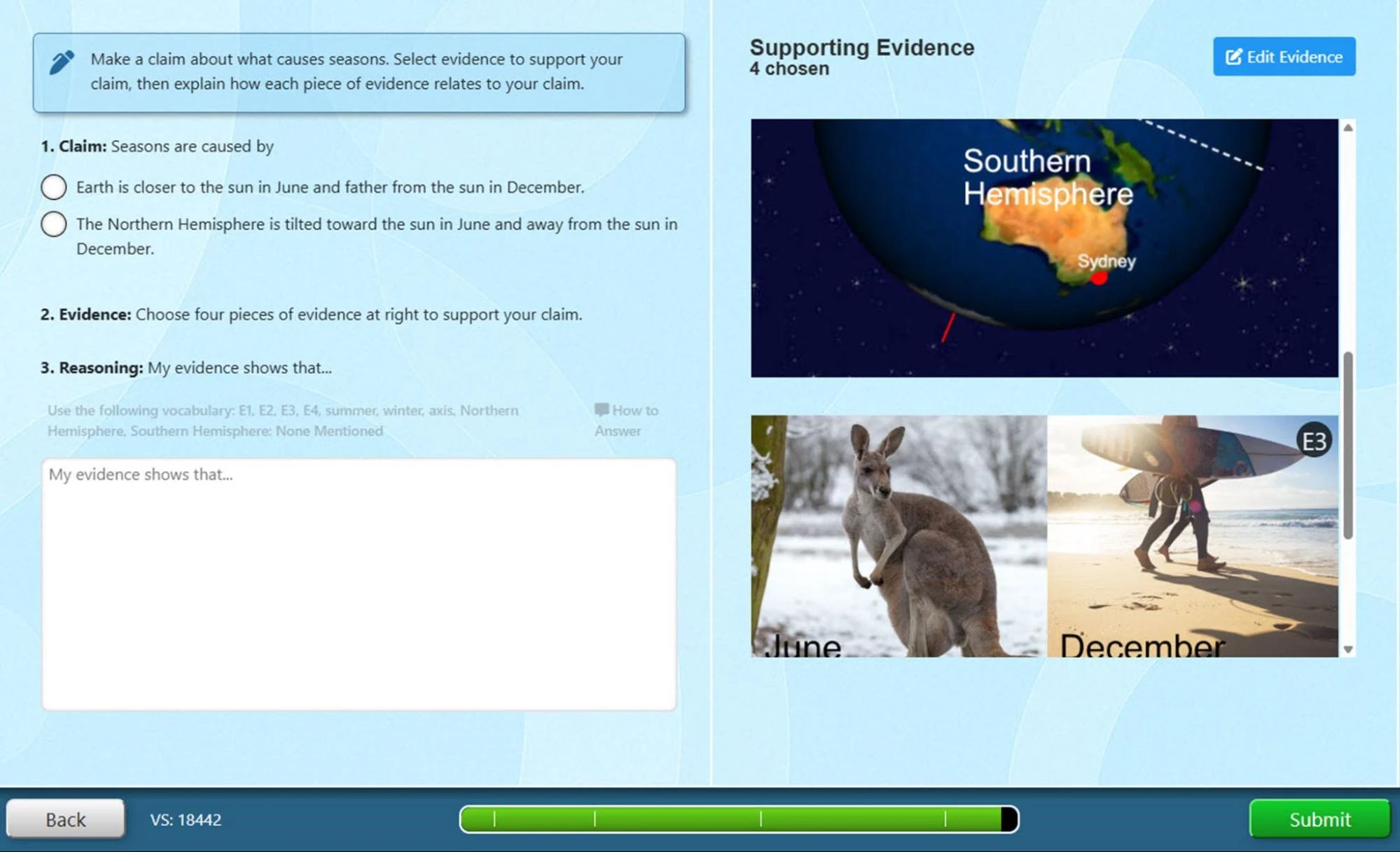
- Explain how Earth’s tilt affects solar intensity, day length, and temperature
By manipulating variables such as Earth’s tilt, orbital position, and angle of sunlight, Gizmos Investigations make invisible processes visible. Students can directly observe why the Northern and Southern Hemispheres experience opposite seasons, deepening their conceptual understanding without adding to your prep time.
Extend learning with flexible, one-day season lessons
The Causes of Seasons Investigation includes two shorter, standalone lessons for focused, single-period explorations:
- Summer Down Under: Why does Sydney, Australia, experience winter while New York experiences summer? Students solve this question by collecting and analyzing data on day length and solar intensity, comparing models, and using evidence to conclude that Earth’s axial tilt causes opposite seasons.
- Mystery of the Midnight Sun: Why are seasons in the Arctic so extreme compared to seasons near the equator? Students compare seasonal conditions in Yellowknife, Canada, and Miami, Florida, using data to explain extreme changes in daylight and temperature patterns at high latitudes.
Try Gizmos to enhance your causes of seasons lessons
Teaching seasons is about more than explaining summer and winter. It’s about helping students understand Earth as a dynamic system. With interactive investigations, real-world stories, and strong data practices, Gizmos helps students confidently explain the causes of seasons and build understanding that supports future science learning.
Try Gizmos free today and bring the science of seasons to life in your classroom.