
You don’t have to look far for powerful entry points into real-world science. They’re already unfolding in your community, in the news, and just outside your classroom window. A space launch (looking at you, Artemis II!), a local river cleanup, a new community garden, or even a fast-growing tree on campus can spark curiosity and transform everyday observations into meaningful student inquiry.
The key is noticing these real-world science moments and using them intentionally. When local, national, or world news ignites a question, lean in with investigations to bring science to life in new ways.
Article summary
- Real-world events and current science news create powerful entry points for student inquiry.
- Phenomena-based investigations help students ask questions, analyze data, and explain evidence.
- Literacy connections build background knowledge and support deeper scientific reasoning.
- Digital tools like Gizmos and Science A-Z make real-world science investigations accessible and engaging.
Why real-world questions matter
Students are naturally more engaged when science connects to their lives. When learning begins with questions about what students see and experience every day, motivation to investigate, reason, and explain follows. This is the heart of phenomena-based learning: grounding instruction in observable events that spark curiosity and drive inquiry.
Instead of starting with vocabulary or a procedure, real-world science questions center a lesson with a motivating problem to solve. Why did that rocket need so much fuel to launch? How does cleaning trash from our river affect water quality? Why are some plants in the school garden growing faster than others?
Questions invite exploration and support authentic scientific inquiry in the classroom.
What is a science investigation?
Science investigations are experiences where students ask questions about a phenomenon, gather and analyze evidence, test ideas or hypotheses, and use data to explain their observations. Investigations can be hands-on, such as conducting lab experiments or collecting measurements in the classroom or outdoors, or virtual, using digital tools and simulations that allow students to manipulate variables, model systems, and observe outcomes that may be difficult to explore in a traditional lab.
Launching an investigation doesn’t require expensive equipment or long lab periods. A local weather event, an interactive simulation, or news about a medical breakthrough can all serve as starting points for meaningful science investigations. These varied approaches give students multiple ways to engage in scientific thinking while building skills in evidence-based reasoning.
Using current events as classroom phenomena
Current events in science education give you timely, authentic hooks for learning, especially when topics come from places your students recognize. News stories don’t have to be national headlines to matter. Local and community-level events often create the strongest connections and the most meaningful student inquiry in science.
Here are some sample ways to connect science topics to local, national, and global news.
Local phenomena that students can investigate
Day-to-day events help students see science as something that’s happening around them, not just in textbooks.
Examples include:
- Sudden weather changes (heat waves, storms, flooding, drought)
- Plant or animal behavior on your school property or in the surrounding neighborhoods
- Changes in air quality, water clarity, or soil conditions
- Construction projects, road repairs, or erosion after rain
- Seasonal shifts in daylight, temperature, or local ecosystems
- Community health topics (allergies, asthma alerts, mosquito activity)
These real-world science examples encourage observation, data collection, and pattern-seeking using familiar surroundings.
National and global headlines that spark big questions
Some stories invite students to think beyond their community while still engaging deeply with science concepts, including:
- Space exploration missions and new discoveries
- Earthquakes, wildfires, hurricanes, and other natural hazards
- Medical breakthroughs, vaccines, or disease outbreaks
- Climate trends, ice melt reports, or biodiversity loss
- Advances in renewable energy or new technologies
- Environmental challenges like plastic pollution or water scarcity
These headlines naturally lead to questions about systems, cause and effect, and how science impacts people worldwide.
Connect literacy with phenomena to spark investigation
Reading strengthens inquiry by helping students build context and deepen thinking before testing ideas, bridging curiosity and meaningful scientific investigation.
Literacy-connected resources for elementary students
Purposeful texts build background knowledge, introduce key vocabulary, and clarify complex ideas connected to a phenomenon, so students can investigate using evidence, not guesses.
If you’re teaching elementary-aged students, explore Science A-Z for an extensive collection of scaffolded texts, engaging activities, and hands-on experiments that make it easy to incorporate real-world science into the K-6 classroom. Phenomenon-based lessons blend essential practices with core ideas while engaging students in reading, writing, collaboration, and investigation.
Science A-Z also includes Science in the News, an engaging monthly periodical that covers the ever-changing world of science. Each issue features compelling science news articles for kids, written at three reading levels to support differentiated instruction.
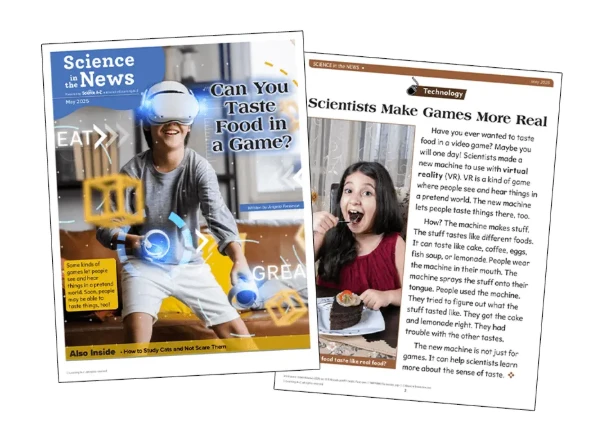
Science in the News issues engage students with real-world science topics.
Gizmos virtual simulations also include a variety of literacy connections to build background knowledge and incorporate reading and writing skills.
Inspire middle and high school students with story-based investigation
As students move into middle and high school, literacy becomes more analytical, but just as essential to scientific inquiry. Authentic texts help students wrestle with complexity, evaluate evidence, and investigate science as it exists in the real world.
Effective literacy connections at this level include:
- News articles tied to current scientific challenges or discoveries
- Case studies that present real-world problems without preset answers
- Data-rich texts that require interpretation and reasoning
- Multiple perspectives on the same scientific issue
Gizmos STEM Cases blend real-world stories, authentic data, and interactive simulations, giving older students the chance to investigate problems through the lens of a STEM professional. As they work through a case, students apply foundational knowledge, test ideas through guided virtual inquiry, and ultimately communicate their reasoning and evidence by writing a concise case summary report.
Power real-world science investigations with Gizmos
You might be wondering, “How do I get students doing real science investigations?” Once students are asking questions, the next step is to help them investigate through real scientific practice. Gizmos turn real-world curiosity into hands-on, data-driven investigation.
The Gizmos content library made up of interactive Simulations, STEM Cases, and Investigations let students explore science concepts in ways that are safe, repeatable, and classroom-ready. With Gizmos, students can:
- Manipulate variables and run multiple trials
- Test hypotheses tied to real-world events
- Collect and analyze data
- Clearly see cause-and-effect relationships
Since science investigations remove common barriers, like limited time, materials, or safety concerns, students can focus on scientific reasoning. Students test ideas, revise thinking, and analyze results in ways that mirror real scientific work. Paired with current events or classroom phenomena, Gizmos help students move from “What’s happening?” to “Why is this happening, and how can I test it?”
Sample ways to infuse Gizmos with current events:
- After a space launch headline, have students explore force and motion through a physics simulation.
- Following an earthquake, wildfire, or extreme weather headline, students can use Earth science Gizmos to model plate movement, erosion, or energy transfer and investigate how environmental variables affect natural hazards.
- After a headline about population changes, students can model food chains, predator–prey relationships, and other species interactions with wildlife and ecosystem simulations.
Gizmos Investigations further support inquiry-based learning by anchoring abstract concepts in real-world questions. These scaffolded, high-quality instructional materials for middle school include built-in questioning and just-in-time feedback, helping students make sense of complex phenomena as they work toward evidence-based explanations.
Putting it all together: From curiosity to real-world science learning
With real-world questions and active classroom investigation, your role shifts from delivering information to facilitating discovery. You guide discussion, prompt deeper questions, and help students connect evidence back to real-world events and questions.
As students investigate relevant phenomena this way, science becomes meaningful and authentic, allowing them to truly begin to think like scientists. Ready to bring real-world investigation into your classroom? Start a free trial of Gizmos or Science A-Z to give students the tools to explore, test ideas, and learn science by doing.