
If you’re looking for a way to help your students connect science to the real world, you’ll love the newest Gizmos interactive STEM Case: Fighting Floods: The Water Cycle and Climate Change. This STEM Case puts your students in the role of a hydrologist, with an authentic problem to investigate, analyze, and solve.
This interactive experience brings the water cycle and climate change to life, challenging students to use data and engineering design to help a community at risk. It’s inquiry-based learning with real-world impact.
Give your students a story they can step inside
In this STEM Case, students explore Paanee, a city in Northeast India that’s flooding more often than ever. As students work through the case study, they’ll discover how climate change is affecting the water cycle—and what that means for real communities.
Your students analyze data, investigate the science behind extreme weather, and design a solution to help protect the people of Paanee. It’s hands-on, relevant, and a powerful way to show students why science matters beyond the classroom walls.
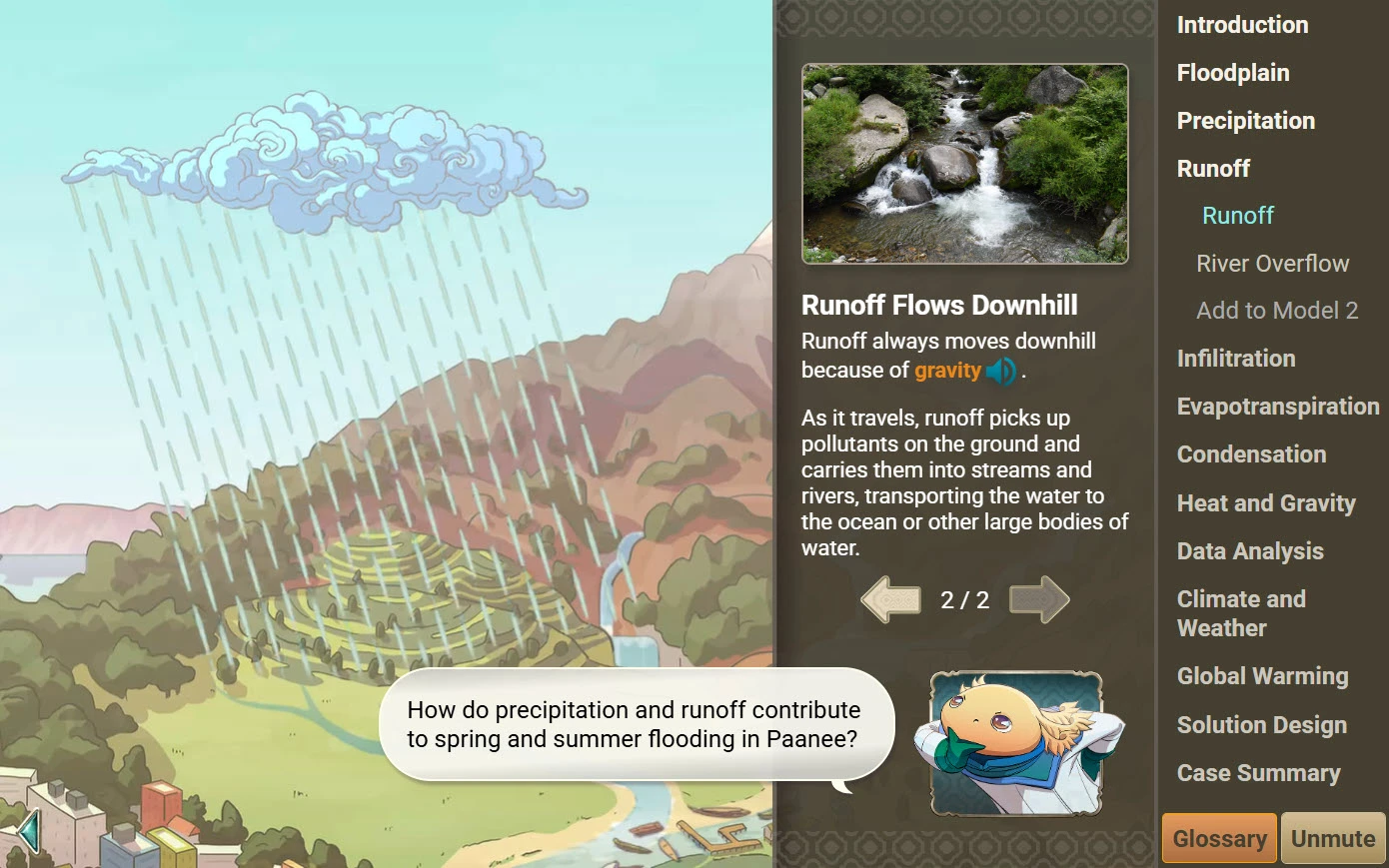
Students explore the water cycle in Paanee, India.
Water cycle basics: Quick Q&A for your lesson
Use these reference points to build background knowledge and set up students to thrive in the STEM Case.
What is the water cycle (hydrologic cycle)?
The water cycle (also called the hydrologic cycle) is the continuous circulation of water through Earth’s land, ocean, atmosphere, and living things. The main processes in the water cycle include evaporation, transpiration, condensation, precipitation, runoff, and infiltration. Gravity and heat drive water’s movement and changes in form.
Why is the water cycle important?
The water cycle redistributes freshwater, regulates climate, and supports every ecosystem and community on Earth. It affects weather patterns, water availability for drinking and agriculture, and the health of rivers, soils, and forests.
What are the stages of the water cycle?
While models vary, most classroom water cycle diagrams include these core processes:
- Evaporation: Liquid water becomes water vapor due to heat from the sun.
- Condensation: What is condensation in the water cycle? It’s when water vapor cools and changes back into liquid droplets, forming clouds.
- Precipitation: Water falls to Earth as rain, snow, sleet, or hail.
- Infiltration: What is infiltration in the water cycle? It’s water soaking into the ground, replenishing soil moisture and aquifers.
- Runoff: What is runoff in the water cycle? It’s water flowing over land into streams, rivers, and lakes—often increasing after heavy precipitation.
- Transpiration: What is transpiration in the water cycle? Plants release water vapor from their leaves into the air as waste in the transpiration process.
- Collection and storage: Water gathers in oceans, lakes, rivers, glaciers, snowpack, and groundwater.
Water cycle and climate change: What’s the connection?
How are the water cycle and climate change connected? Remember that weather describes the conditions at a particular moment, including temperature, precipitation, cloud cover, humidity, air pressure, and wind. The weather may change from one moment to the next, while the climate is an average of weather conditions over many years. A change in weather patterns over time indicates a change in climate.
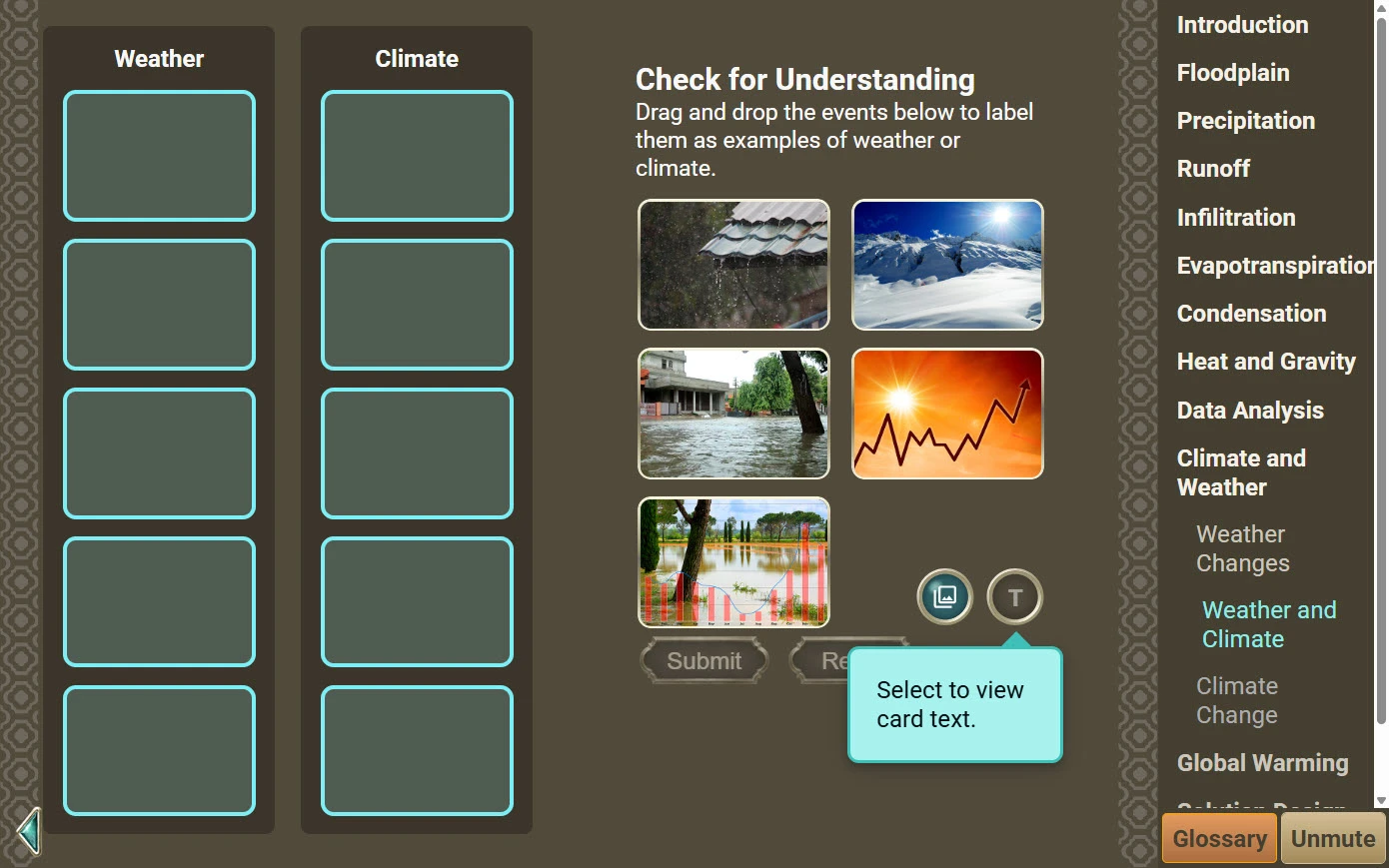
Students compare weather and climate in the Fighting Floods STEM Case.
As greenhouse gases increase, global temperatures rise. Warmer air holds more moisture and speeds up evaporation. That can mean heavier downpours and flooding in some places and longer droughts in others. Melting snowpack shifts seasonal water availability, and sea-level rise can worsen coastal flooding. In short: climate change intensifies parts of the hydrologic cycle, creating new challenges for cities like Paanee—exactly the scenario your students explore in the STEM Case.
Support standards-aligned science learning while keeping students engaged
The Fighting Floods STEM Case is built to help your middle schoolers master key science and engineering practices while staying engaged in meaningful work.
By the end of the lesson, students will be able to:
- Describe how heat and gravity drive Earth’s water cycle.
- Define weather and climate and identify examples of each.
- Explain how human activities intensify the greenhouse effect and lead to global warming.
- Describe how climate change and the water cycle influence each other.
- Analyze graphs to identify trends in data, describe relationships between variables, and predict future trends.
- Design and optimize a solution to mitigate extreme flooding.
You get a single resource that blends scientific sensemaking, data literacy, problem-solving, and engineering design—grounded in a realistic hydrologic cycle challenge that students care about.
How the STEM Case drives engagement with the water cycle
The Fighting Floods STEM Case brings real-world science to life for students, extending concepts beyond a textbook for meaningful problem-solving.
- Authentic role: Students act as hydrologists, using real-world data to reason about the water cycle and propose solutions.
- Concept-to-application: Core ideas (evaporation, condensation, transpiration, infiltration, runoff) move from vocabulary to lived practice.
- Visual models: Interactive scenes serve as a dynamic water cycle diagram, helping students connect processes and feedback loops.
- Engineering mindset: Students design, test, and optimize flood-mitigation solutions—linking science understanding to community impact.
- Assessment-ready: Graph analysis, trend identification, and claims-evidence-reasoning prepare students for standards-aligned assessment tasks.
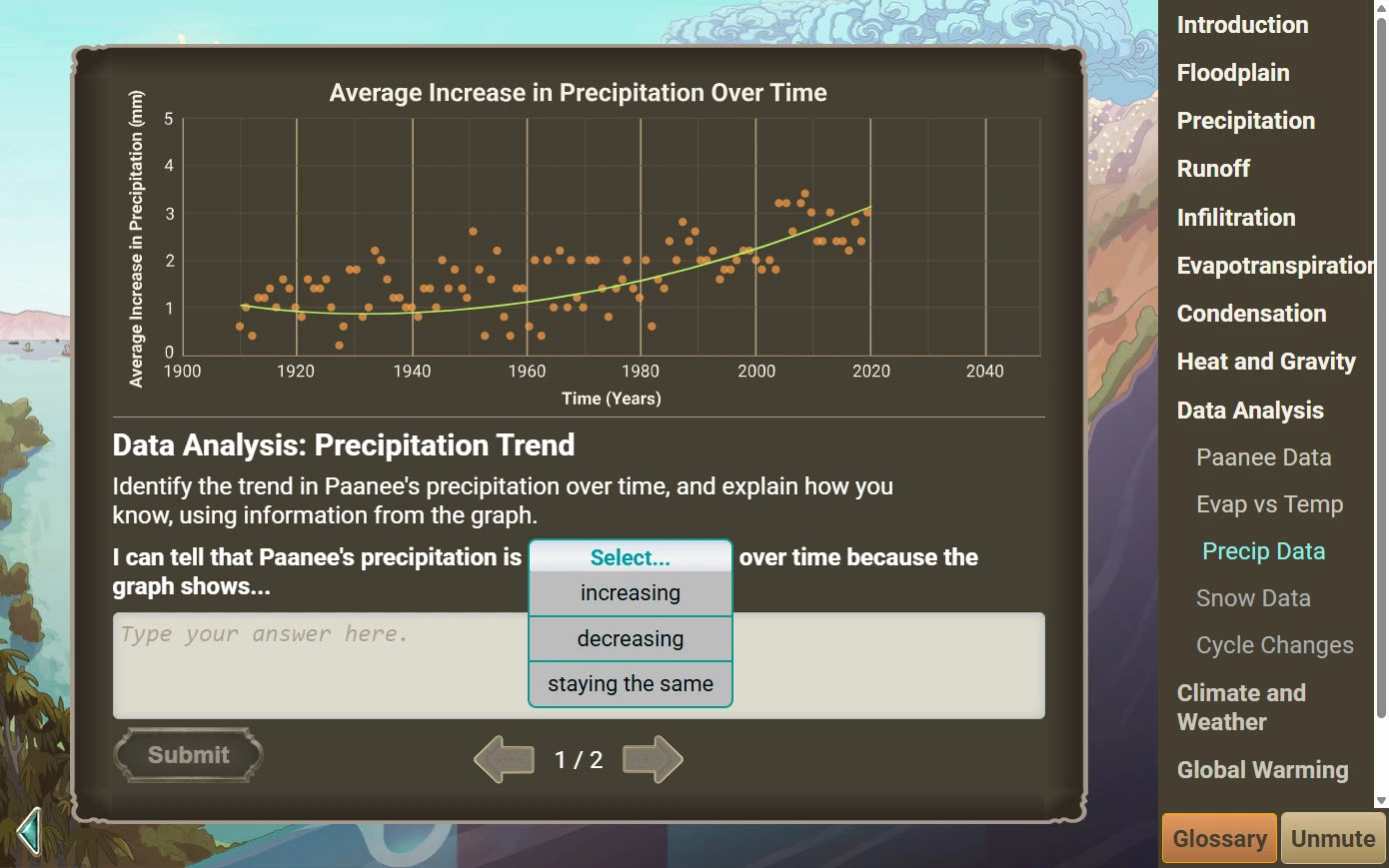
Students analyze data and explain their reasoning in the STEM Case.
If you teach older students who are ready for deeper modeling and systems thinking, explore the Hydrologic Cycle STEM Case designed specifically for high school.
Fighting Floods: Built with insights from real STEM professionals
This STEM Case was developed in close collaboration with STEM Professionals who shared real-world expertise to help shape meaningful, authentic learning experiences for students.

Dr. Paulami Banerjee, PhD, an environmental scientist with extensive research experience in India and a PhD in Environmental Science and Engineering, contributed deep insight into the environmental and cultural context of flooding in Northeast India. Her background in curriculum design and university teaching helped ensure the STEM Case is both scientifically rigorous and accessible for middle-school learners.
Nekeshia Lake, EH, MPH, is an Earth Science teacher and Environmental Health specialist who brought her field experience in environmental protection, watershed management, and community-based conservation to the development process. Her work with organizations such as the EPA, Georgia EPD, and the Chattahoochee Riverkeepers, along with her classroom expertise, helped ground the STEM Case in real-world environmental challenges students can relate to.
.webp)
“The Fighting Floods STEM Case helps students see how science is used to solve real-world problems that impact communities. By analyzing data and exploring solutions, students learn how scientists and engineers work together to reduce flood risks and protect people and the environment. Experiences like this help students understand that the science they learn in class can be applied to real challenges in the world around them,” said Lake.
Banerjee echoed the sentiment. “It has been an incredibly rewarding experience for me to collaborate on this project and bring this real-world simulation to life. The Fighting Floods STEM Case provides students with the opportunity to move beyond theory and step into the role of problem solvers, tackling a real-world environmental crisis.”
Banerjee and Lake’s knowledge helped shape everything students experience in the STEM Case, from the authentic datasets and flooding scenarios to the engineering constraints students must consider when designing solutions. By grounding Fighting Floods in the insights of professionals who work with the hydrologic cycle every day, your students get a realistic, meaningful look at how science is used to solve real-life problems.
Bring this interactive STEM experience and more into your classroom
Try Gizmos to access this new STEM Case and the entire library of 550+ interactive simulations, turnkey Investigations, and real-world case studies—built to make the water cycle (and so much more) meaningful, measurable, and fun for your students.
Get started today to access Fighting Floods and a wide variety of related earth science and climate science simulations.